
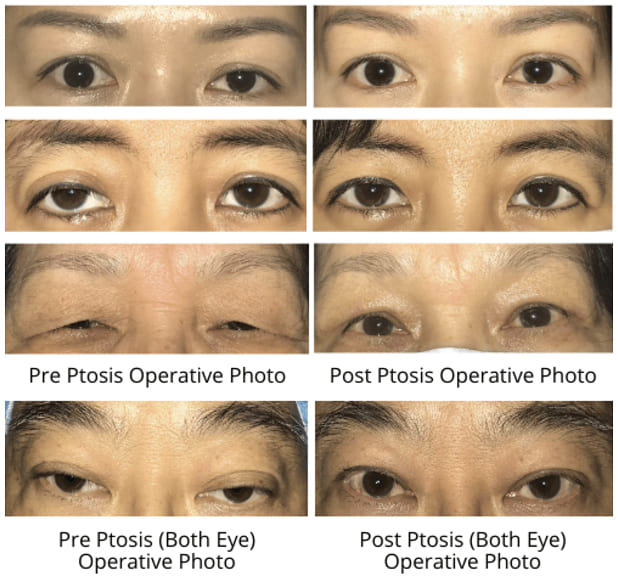
Ptosis is drooping of the upper eyelid. The droop may be mild or barely noticeable, or in severe cases, the drooping eyelid may cover the entire pupil and interfere with vision. Ptosis can affect one or both eyes. It can affect both children and adults, but usually occurs because of aging.
Depending on how severely the lid droops, people with ptosis may have difficulty seeing or driving. Sometimes, people with ptosis tilt their heads back to try to see under the lid or raise their eyebrows repeatedly to try to lift the eyelids. They generally look tired and sleepy.
Ptosis may be congenital or acquired. Congenital ptosis is usually present at birth while acquired ptosis develops later in life and may be due to aging, injury, following cataract surgery, Botox injection, contact lens use, eye tumour, neurological disorder or systemic disease like diabetes.
The most common cause of ptosis is injury or stretching and deshisence of the eyelid muscle that would normally lift the eyelid, called the levator aponeurosis muscle.
Ptosis can be a warning sign that a more serious condition is affecting the muscle, nerve, brain or eye socket. Ptosis that develops over a period of days or hours is more likely to signify a serious medical problem.
For childhood ptosis, it is important to assess the child vision and refraction (as childhood ptosis is often associated with astigmatism). Baby born with moderate or severe ptosis require surgical treatment in order for proper vision to develop. Failure to treat ptosis can result in amblyopia (lazy eye) and a lifetime of poor vision.
| Condition | Underlying Cause | Primary Treatment |
|---|---|---|
| Ptosis (True Eyelid Droop) | Weakness, stretching, or seperation of the levartor muscle lifting the upper lid | Ptosis Repair Surgery (Levator Advancement or Frontalis Sling) |
| Dermatochalasis | Excess skin and laxity in the upper eyelid due to aging or loss of elastictiy | Upper Eyelid Blepharoplasty (Eyelid Lift) |
| Eyebrow Ptosis | Sagging or drooping of the brow tissue pushing down onto the eyelid | Brow Lift / Forehand Lift |
Surgery usually is the best treatment for drooping eyelids. The surgery involves tightening the levator aponeurosis muscle to lift the eyelids, which will improve the vision and appearance.
For very severe cases involving weakened levator aponeurosis muscle, the surgery involve attaching the eyelid under the eyebrow with sling. This will allow the forehead muscle to substitute the levator aponeurosis muscle in lifting the eyelid.
To see your doctor immediately if you have a drooping eye that:
OasisEye Specialists provides comprehensive oculoplastic, orbital, and lacrimal sub-specialty care across Malaysia. Our fellowship-trained oculoplastic surgeons combine delicate microsurgical precision with aesthetic expertise to diagnose and treat functional, reconstructive, and cosmetic conditions affecting the eyelids, tear drainage system (lacrimal tract), and eye socket (orbit). Our specialist team comprises of Dr Tai Lai Yong, and Dr Kala Sumugam.
Ptosis refers to the drooping of the upper eyelid margin itself due to a weak or stretched levator muscle. Dermatochalasis is the presence of loose, excess skin hanging over the eyelid while the eyelid muscle position remains normal. Both can occur simultaneously and require different surgical techniques.
Yes. If a droopy eyelid covers the pupil during early childhood development, it blocks visual stimulation to the brain, which can lead to amblyopia (lazy eye), astigmatism, or permanent visual loss if not treated promptly.
In adults, ptosis is most commonly age-related (involutional ptosis), caused by the gradual stretching or detachment of the levator muscle tendon. Other causes include eye trauma, prior eye surgeries (like cataract removal), long-term contact lens wear, or neurological conditions.
Ptosis surgery can be both functional and cosmetic. It is considered functional when the drooping eyelid impairs your upper field of vision, interferes with driving or reading, or causes eye strain. It also improves visual balance and facial symmetry.
Ptosis surgery is typically performed as a day procedure under local anesthesia (with light sedation). The oculoplastic surgeon either tightens the levator muscle (levator advancement) or, in severe muscle weakness, connects the eyelid to the forehead muscle using a sling (frontalis sling surgery).
Initial swelling and mild bruising usually improve within 1 to 2 weeks. Most patients resume non-strenuous daily activities within a few days, while final healing and eyelid contour refinement stabilize over 4 to 6 weeks.
A droopy eyelid is a medical emergency if it develops suddenly within hours or days, or if accompanied by double vision, uneven pupil sizes, severe headache, face/limb weakness, or speech difficulties. This requires immediate neurological or emergency medical evaluation.
Surgical incisions are placed within the natural crease of the upper eyelid, making scars discrete and difficult to notice once fully healed. In some internal approaches (conjunctival resection), there are no visible external scars.
While ptosis surgery provides long-lasting correction, natural aging or tissue laxity over time can occasionally cause mild recurrent droopiness years later. Revision surgery can be performed if needed.
Your oculoplastic surgeon determines the procedure based on the function strength of your levator muscle. If the muscle still has good function, levator tightening is chosen. If the muscle function is poor (often in congenital cases), a frontalis sling is used to allow forehead muscles to lift the eyelid.
At OasisEye Specialists, ptosis surgery per eye typically ranges from RM4,500 to RM6,500. International patients are subjected to an additional 6% SST.