
| Feature | Epi-Off CXL (Epithelium Removed) | Epi-On CXL (Transepithelial) |
|---|---|---|
| Corneal Surface Layer | Epithelium removed to ensure deep Riboflavin penetration | Epithelium left intact using specialized formulation |
| Main Objective | Maximum corneal bond strength and proven long-term stabilization | Enhanced patient comfort and minimal recovery downtime |
| Post-Op Discomfort | Mild to moderate grittiness/pain for 3 to 5 days while surface heals | Minimal discomfort; faster visual recovery |
| Bandage Contact Lens | Worn for 3 to 7 days until re-epithelialization | Generally not required or worn for 1 day |
1. Topical Anesthesia: Numbing eye drops applied for a painless procedure.
2. Epithelial Preparation: Gentle removal of the outermost corneal layer (Epi-Off method).
3. Riboflavin Absorption: Application of Vitamin B2 drops every 2 minutes for 15–30 minutes until the cornea is saturated.
4. UVA Light Activation: Precision ultraviolet – A light is shone onto the cornea to activate cross-linking bonds.
5. Protection & Healing: A protective bandage contact lens is placed to promote comfortable healing.
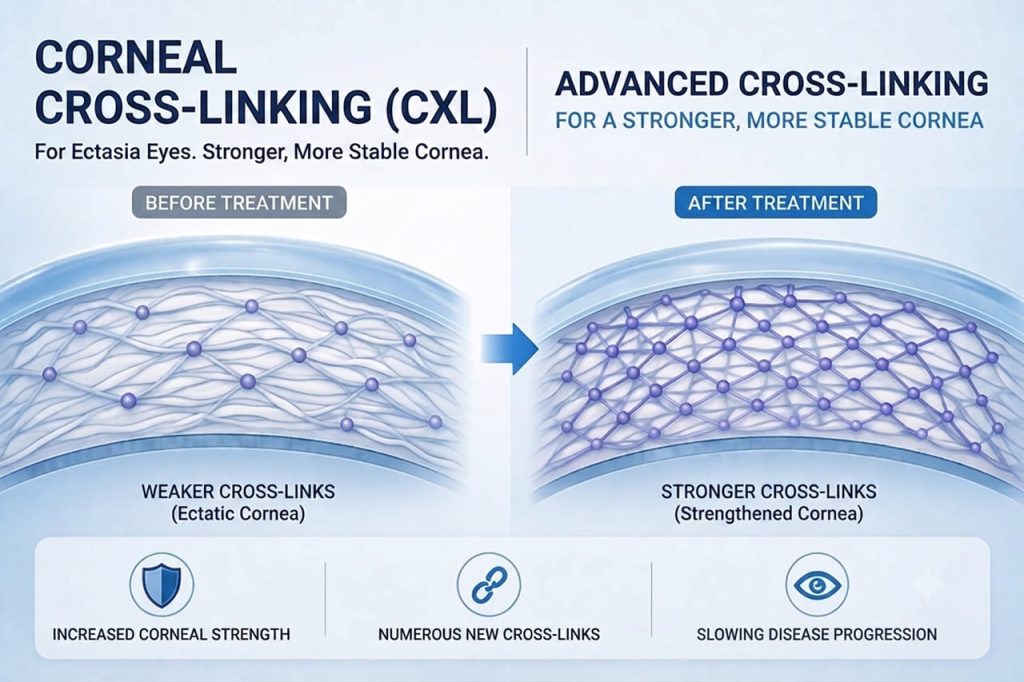
Corneal Collagen Cross-Linking (CXL) is a minimally invasive outpatient procedure that uses Riboflavin (Vitamin B2) eye drops combined with controlled Ultraviolet-A (UVA) light to create new chemical bonds in the corneal tissue, increasing its structural strength by up to 300%.
CXL is designed primarily to halt or slow down the progression of keratoconus, rather than reverse it. While its main goal is stabilization, some patients experience slight flattening of the cornea and modest visual improvements over time.
The entire procedure takes approximately 45 to 60 minutes per eye. This includes topical numbing, 15 to 30 minutes of Riboflavin eye drop application, and UVA light exposure.
The procedure itself is painless because numbing eye drops are used. Patients undergoing Epithelium-Off (Epi-Off) CXL may experience mild to moderate discomfort, grittiness, or light sensitivity for 3 to 5 days post-surgery while the outer corneal layer heals.
In Epi-Off CXL, the thin outer layer (epithelium) of the cornea is gently removed to maximize Riboflavin penetration into the corneal stroma. In Epi-On CXL, the epithelium remains intact, offering faster recovery but slightly lower absorption rates in some cases.
It is generally recommended to wait 2 to 3 months after CXL before prescribing new glasses or rigid/scleral contact lenses. This allows the corneal shape and vision refraction to fully stabilize following treatment.
CXL is a safe procedure with a low complication rate. Normal temporary side effects include light sensitivity and haze. Potential rare risks include delayed epithelial healing, corneal infection, temporary blurred vision, or corneal scarring.
Ideal candidates are teenagers and adults diagnosed with progressive keratoconus, post-refractive ectasia, or pellucid marginal degeneration who still possess sufficient corneal thickness (typically >400 microns).
Keratoconus progresses most rapidly in teenagers and young adults. Early screening with corneal topography allows specialists to perform CXL early, preserving native visual acuity and preventing the need for future corneal transplant surgery.
No. Eye rubbing should be strictly avoided, especially during the first few weeks after CXL. Rubbing can dislodge the healing epithelial layer, increase infection risk, and aggravate underlying corneal weakness.
At OasisEye Specialists, cornea cross-linking per eye typically ranges from RM4,000 to RM7,500. International patients are subjected to an additional 6% SST.