Can Cataracts Be Cured Without Surgery?

Man looking surprised while holding a box of cataract removal eye drops, questioning if the product’s claims are true

Cataracts are a common eye condition where the natural lens becomes cloudy, leading to blurry vision. While mostly age-related, cataracts can affect anyone and often develop gradually over time.
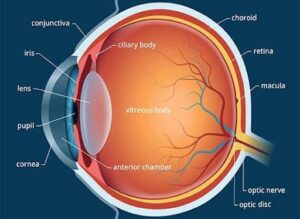
Cross-sectional diagram of the human eye showing the cornea, lens, iris, pupil, retina, optic nerve, and other structures relevant to cataract formation.

Source: Autumn Sprabary 

What Causes Cataracts?

Cataracts form when proteins in the eye’s lens break down and clump together. Common causes include:

  • Aging
  • UV radiation from sunlight or artificial sources
  • Oxidative stress (smoking)
  • Diabetes
  • Eye or head injury
  • Prolonged steroid use


Types of Cataracts

Cataracts can be classified depending on the location where they form, for example:

  • Nuclear – Central part of the lens, yellows over time
  • Cortical – Edge-based spokes moving inward
  • Posterior Subcapsular – Back of the lens
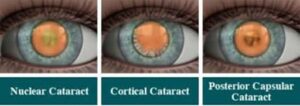
Comparison of three main types of cataracts: nuclear cataract affecting the lens centre, cortical cataract forming spoke-like edges, and posterior subcapsular cataract at the back of the lens

Source: Eyeguru


Can Cataracts Go Away on Their Own?

Unfortunately, cataracts do not go away or reverse on their own as it is a physical change to the lens itself. Once the lens becomes cloudy, it cannot return to being clear. No eye drops, diet changes, supplements or exercises have been proven to reverse or “cure” cataracts.
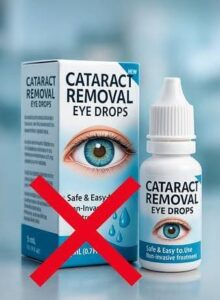
Cataract removal eye drops with a red cross symbol, illustrating that eye drops cannot cure or remove cataracts.


How About Delaying It?

While there are no proven methods to reverse or cure cataract without surgery, certain habits may help slow their progression:

  • Wear UV-protective sunglasses – Ultraviolet (UV) light from the sun can damage the lens over time.
  •  Avoid smoking – Smoking increases the risk of cataracts. Quitting can benefit your eyes and overall health.
  • Manage health conditions – Conditions like diabetes and high blood pressure can speed up cataract formation.
  • Use protective eyewear – If you work with chemicals or in environments where eye injuries are possible, safety glasses can prevent lens damage.
  • Have regular eye exams – Detecting early changes allows for better management and timely advice.


When Should You Consider Surgery?

If cataracts are affecting your ability to read, drive, or do daily tasks, it may be time to talk to your eye specialist about surgery. The good news is that cataract surgery is highly successful, quick (often under 20 minutes), and requires minimal recovery time.

If you have certain medical conditions, such as diabetes or high blood pressure, your eye specialist may put you on a treatment plan to control your condition before your cataract surgery, so that the surgery can proceed without added risks during or after the surgery.


Treating Cataracts

The only definitive and effective treatment for a cataract is surgery. Known as phacoemulsification, this procedure involves the use of ultrasonic waves to break the cataract into small fragments, which are subsequently suctioned out of the eye through a small incision.
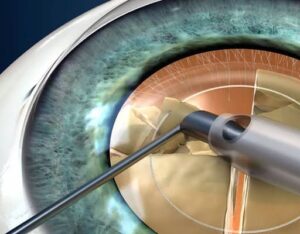
Close-up illustration of cataract surgery showing an instrument breaking and suctioning the cloudy lens during phacoemulsification.

Source: Roque 

After the cataract is removed, a clear intraocular lens (IOL) is implanted into the lens capsule to restore vision. This is a safe and common procedure that usually takes about 20 minutes. IOL can be divided into 3 groups:

  • Monofocal IOL – Clear distance vision; reading glasses needed
  • Extended Depth of Focus (EDOF) IOL – Smooth focus across distances and intermediate
  • Multifocal IOL – Seamless transition between distance, intermediate and near

Visual comparison of monofocal, extended depth of focus, and multifocal intraocular lenses showing different clarity levels when viewing a phone and background objects after cataract surgery.

The selection of IOL is based on one’s visual demand and eye condition.


Post-Surgery Care Tips

After surgery, proper care is crucial for healing:

  • No heavy lifting or bending over
  • Use an eye shield, wear sunglasses, avoid rubbing
  • Use prescribed drops on time
  • Attend follow-up visits
  • Avoid swimming, eye makeup, or dusty environments
  • Call your doctor if you notice pain, redness, vision changes, or discharge.


Conclusion

If cataracts are impacting your quality of life, the safest and most effective solution is to talk to an ophthalmologist about cataract surgery. It’s a life-changing procedure that can restore your vision and help you get back to doing the things you love. There is no way to remove cataracts without surgery. While glasses or better lighting can help temporarily, the only proven treatment to restore clear vision is cataract surgery.

If you suspect yourself of having a cataract or notice changes in your vision, see an eye specialist for a proper diagnosis and advice.


FAQs

Lorem ipsum dolor sit amet, consectetur adipiscing elit. Ut elit tellus, luctus nec ullamcorper mattis, pulvinar dapibus leo.

Lorem ipsum dolor sit amet, consectetur adipiscing elit. Ut elit tellus, luctus nec ullamcorper mattis, pulvinar dapibus leo.

Katarak

Katarak (cataract dalam bahasa Inggeris), atau juga dikenali sebagai selaput dalam adalah sejenis penyakit mata yang menyebabkan penglihatan menjadi kabur. Ianya terjadi apabila kanta semulajadi mata yang jernih bertukar menjadi keruh sehingga cahaya tidak dapat menembusnya dengan sempurna. Antara faktor utama terjadinya katarak adalah seperti proses penuaan, kecederaan mata, penyakit-penyakit seperti kencing manis (diabetes) dan penggunaan ubat steroid untuk jangka masa panjang. Katarak lebih kerap berlaku dalam kalangan orang dewasa yang berusia, namun ia juga boleh berlaku dalam kalangan kanak-kanak dan ia dikenali sebagai katarak kongenital.

Tanda & gejala

  • Penglihatan kabur tanpa rasa sakit
  • Kesukaran memandu terutamanya pada waktu malam
  • Warna kelihatan pudar atau perubahan persepsi warna
  • Kerap menukar preskripsi cermin mata
  • Silau (lampu kereta, cahaya lampu atau cahaya matahari kelihatan sangat terang)
    Penglihatan berganda pada sebelah mata (monocular diplopia)

Rawatan

Katarak boleh menganggu aktiviti harian dan menyebabkan kebutaan jika tidak dirawat. Sehingga kini tiada lagi rawatan berasaskan ubatan-ubatan yang boleh menyembuhkan katarak. Satu-satunya rawatan katarak yang berkesan adalah pembedahan. Sekiranya penglihatan cukup baik dengan menukar preskripsi cermin mata, pembedahan tidak perlu dilakukan untuk sementara waktu. Pembedahan hanya dijalankan di wad rawatan harian yang mana pesakit tidak perlu bermalam di hospital. Semasa pembedahan katarak, kanta mata yang keruh dikeluarkan dari mata dan akan digantikan dengan kanta implan intraokular (IOL) yang kekal.

Kanta intraokular (IOL)

Kanta intraokular (IOL) adalah kanta prostetik atau kanta tiruan yang digunakan untuk menggantikan kanta semula jadi yang sudah keruh semasa pembedahan katarak. Selepas implantasi kanta intraokular (IOL) ke dalam mata, ia kekal dan tidak perlu ditukar seumur hidup. Katarak tidak akan terjadi ke atas kanta intraokular (IOL). Terdapat beberapa jenis kanta yang boleh diimplan ke dalam mata semasa pembedahan. Jenis kanta yang sesuai untuk setiap orang mungkin berbeza mengikut keadaan mata yang dibedah, dan keperluan penglihatan pesakit, dan perlu dibincang bersama pakar mata masing-masing. Berikut adalah pilihan kanta IOL yang boleh digunakan untuk pembedahan katarak.[/vc_column_text][/vc_column][/vc_row][vc_row][vc_column][vc_column_text]

  1. Kanta Monofokal – menawarkan penglihatan yang baik untuk jarak jauh tetapi cermin mata diperlukan untuk membaca jarak dekat.
  2. Kanta Multifokal – menawarkan penglihatan yang baik untuk jarak jauh dan dekat.
  3. Kanta Torik – menawarkan penglihatan yang baik untuk jarak jauh dan pembetulan masalah rabun silau

Langkah-langkah yang boleh diambil untuk memperlahankan pembentukan katarak adalah:

  1. Pakai cermin mata hitam yang mempunyai perlindungan daripada cahaya UV (UV400)
  2. Amalan pemakanan yang seimbang
  3. Senaman fizikal yang berkala
  4. Elakkan merokok
  5. Elakkan penggunaan ubatan steroid tanpa pengawasan daripada doktor

Sesiapa yang menetap di Cheras, Kepong, Petaling Jaya, Puchong dan Shah Alam boleh berkunjung ke pusat kami untuk mendapat pemeriksaan mata yang menyeluruh dan nasihat daripada pakar mata kami.

June is Cataract Awareness Month!

What is cataract?

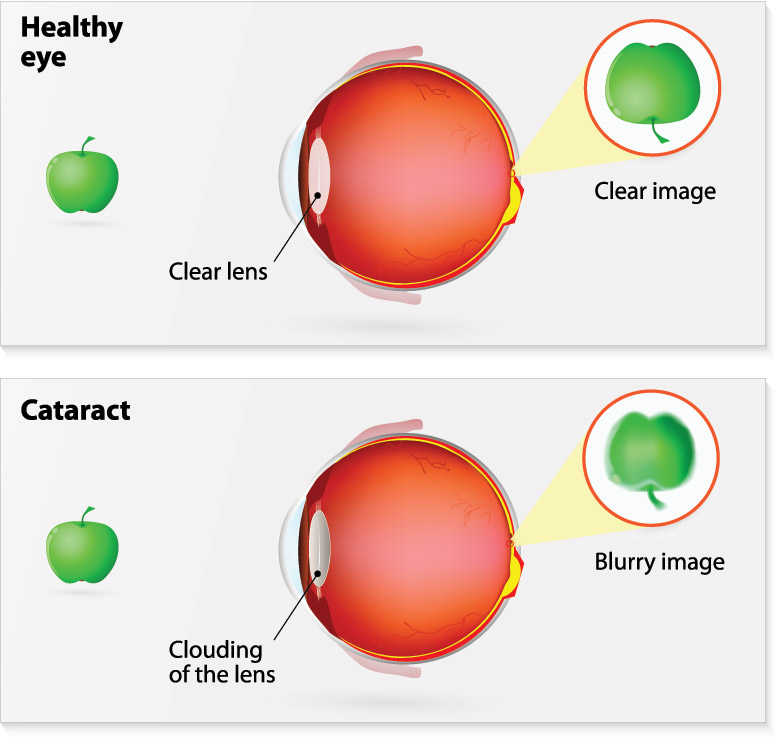
Cataracts are common and occur naturally as we get older. It forms when the lens inside our eye changes with age and becomes less transparent and more cloudy, much like how old glass gets cloudy. Over time, a cataract will progressively get worse, gradually making your vision more blurred.

Healthy eye vs cataract: clear lens gives sharp vision, cloudy lens causes blurry vision.

Who develops cataract?

The main risk factors for developing cataract are as follows:

  • Age
  • Diabetes
  • Trauma (impact to the eye or head)
  • Certain medications (such as steroids)
  • Eye surgery for other conditions
  • Other possible causes: UV exposure,
  • smoking & vitamin malnutrition

What are the signs and symptoms?

  • Cloudy, fuzzy, foggy or filmy vision
  • Alteration in appearance of colours
  • Difficulty driving at night
  • Severe glare from lights or the sun
  • Frequent changes in your spectacle prescription
  • Seeing double (even with one eye closed)
  • Better near vision for a while

What should I do if I think I have cataract?

Deciding on cataract surgery may not be straight-forward. If you feel your vision is blurred you can get examined by an optometrist or an eye doctor. If new glasses don’t improve your vision and your doctor tells you there are cataracts, then you might want to consider cataract surgery. An eye test can give you an idea of how good your vision is. However, surgery is not recommened simply based on your eye test. You should think about how and whether your quality of life is being affected by your vision. For an example, if you enjoy playing golf or reading, or you need to drive a car, you may want to have cataract surgery sooner.

What if I do not want cataract?

If you choose not to have treatment now, you can always change your mind in the future, if and when your cataracts start to trouble you. It is not advisable to wait until cataracts get very advanced before you opt to have surgery.

Although your sight is likely to be better after you’ve had a cataract removed, you might still need to wear glasses for certain tasks. Therefore, if you can still see well enough with glasses to do the things you want, you may delay having surgery.

Sometimes, people have other eye problems that needs treating, and the cataract is in the way. For an example, some people get damage to the retina because of diabetes etc. If you need surgery for any other condition, your doctor may then recommend that it would be better to have the cataract removed simultaneously. This would also save you having another operation just for the cataract.

Occasionally, another eye condition can mean you won’t get much benefit out of cataract surgery. And if your health is generally poor, surgery may have more risks. If this is the case, it might be better to avoid having an operation. There are things you can do to try to make your life easier. Get new glasses if you need them, as this will maximise your vision. Brighter lighting, especially where you’re reading, will help. Consider getting an angle-poise lamp or similar light-source for your reading area.

When going out in the bright sunlight, anti-glare sunglasses or a hat with a brim can prevent glare from lights and the sun. Lastly, if you still have difficulty, magnifying lenses may make reading easier – just let your doctor know and they can assess you, send you to an optometrist or ‘Low-Vision Aid’ clinic for further evaluation of what tools would suit you best.