Reviewed by Dr Jimmy Lim Ing Hong, Refractive Surgeon of OasisEye Specialists | Last updated: July 2026
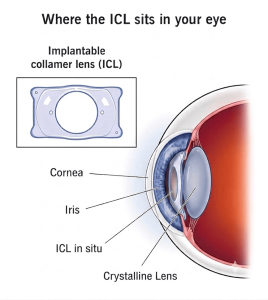
ICL surgery is an intraocular procedure that places a small, micro-thin prescription lens inside the eye, positioned behind the Iris (the coloured part) of the eye and in front of the natural lens. Unlike traditional contact lenses, an ICL remains inside the eye almost permanently (though it can be removed or replaced if necessary) and works in harmony with the natural lens to focus light accurately onto the retina.
Why ICL surgery matters
Refractive errors like myopia (short-sightedness) are a growing global and local concern:
- Childhood Prevalence: A systematic review of Malaysian studies reported childhood myopia at 17.18% overall.
- Adolescent Spike: Prevalence increases sharply to 42.71% among adolescents aged 13 to 18 years.1
- Demographic Factors: Higher rates were observed among females and the Chinese population in the reviewed cohorts.
For adults seeking freedom from heavy spectacle frames or contact lens discomfort, ICL offers a proven alternative—especially when laser vision correction (like LASIK, KLEx or PRK) is anatomically unsuited.
Causes and Risk Factors
ICL surgery does not treat an infection or disease. It corrects a light focusing issue from the ciliary sulcus part of the eye like how a contact lens does on the surface cornea of the eye. These are the common reasons a person may be assessed for ICL surgery:
- The eyeball is too long. Light focuses in front of the retina instead of directly on it, so far objects look blurred; this is called myopia, or short-sightedness.
- The Cornea (front clear window) of the eye is unevenly curved. Light focuses unevenly, so vision may look blurred or distorted at more than one distance; this is called astigmatism.
- The spectacle power is high. Stronger prescriptions may make glasses thicker or contact lenses less comfortable, so lens-based correction may be discussed.
- The cornea may not be ideal for laser reshaping. Some laser procedures work by changing the cornea, the clear front layer of the eye; if the cornea is too thin or irregular, the specialist may recommend another option instead.
- There may be inherited or demographic risk factors for myopia. The Malaysian review reported higher myopia prevalence among females and among the Chinese population in the included studies, but individual suitability still depends on the patient’s own eye measurements.
- The internal eye space and eye health must be safe for a lens. The U.S. Food and Drug Administration patient booklet for EVO ICL lists several situations where surgery should not be done, including pregnancy or nursing, significant glaucoma, and not meeting the required corneal cell safety level as determined by the doctor.
- Patient looking for an alternative to laser vision correction.
Classification: what type of vision problem is being corrected?
For patients, the most useful “classification” is not a disease stage, but the type of focusing problem and which treatment pathway fits safely.
1. Myopia, or short-sightedness
Near objects may look clear, while far objects look blurred. ICL surgery may help by adding a prescription lens inside the eye so light focuses more clearly on the retina. The U.S. Food and Drug Administration’s 2022 EVO ICL page states that the lens is placed behind the iris and in front of the natural lens, and does not replace the natural lens.
2. Myopia with astigmatism
Vision may be blurred or distorted because the eye focuses light unevenly. A toric ICL is a version designed to correct astigmatism as well as short-sightedness. The FDA’s 2022 approval page describes EVO/EVO+ Visian Toric ICL as intended for patients with near-sightedness and astigmatism.
3. Presbyopia, or age-related near focusing difficulty
Some patients in their 40s and above also notice difficulty reading up close. This is a separate focusing issue from myopia. ICL may not remove the need for reading glasses in every patient, and the best option depends on age, near-vision needs, cataract status, and eye measurements.
4. Cataract or early lens changes
If the natural lens is already cloudy, the discussion may shift away from ICL and toward cataract or lens-based surgery. This is because ICL keeps the natural lens in place, while cataract surgery removes and replaces the cloudy natural lens.
In the FDA clinical study summarised on its 2022 device page, 327 patients were followed; at six months, 75.9% of implanted eyes achieved 20/20 vision or better, and 98.9% achieved 20/32 vision.2 These results are encouraging, but they are not a guarantee for every patient.
| Condition | Visual Impact | How ICL Helps |
|---|---|---|
| Myopia | Near objects are clear; far objects are blurry. | Adds a corrective lens in front of the natural lens to focus light on the retina. |
| Astigmatism | Light focuses unevenly, causing distorted vision. | Toric ICL models align with the eye’s axis to neutralize astigmatic distortion. |
| Presbyopia | Age-related loss of close-up focusing (40+ years). | Standard ICL does not stop presbyopia; reading glasses or monovision strategies or EDoF* ICL may be required. |
| Cataract | Clouding of the eye’s natural lens. | ICL is not suitable; treatment shifts to cataract surgery (lens replacement). |
Signs and Symptoms
What can an Ophthalmology Clinician detect?
A patient cannot reliably check ICL suitability at home. During an assessment, the ophthalmology clinical team may check:
- The exact prescription and whether it is stable.
- The corneal shape and thickness.
- The depth and shape of the front part of the eye.
- The health of the corneal endothelial cells, which help keep the cornea clear.
- Eye pressure.
- The retina, especially in patients with high myopia.
- Signs of cataract, glaucoma, inflammation, or other eye disease.
A 2022 U.S. FDA clinical trial report on EVO ICL for moderate myopia measured vision, prescription accuracy, eye pressure, corneal endothelial cell density, and adverse events, showing why the assessment is more than just checking spectacle power.2
What a patient with refractive error might notice at home/outdoor?
You may notice:
- Blurred distance vision.
- Squinting to see far objects.
- Headaches or tired eyes.
- Glare or halos around lights.
- Difficulty driving at night.
- Contact lens induced dryness or intolerance.
- A frequent need to update glasses or contact lenses.
The National Eye Institute lists blurry vision, glare or halos, squinting, headaches, eye strain, and focusing difficulty as symptoms of refractive errors. Seek an eye assessment if these symptoms appear, worsen, or remain troublesome despite glasses or contact lenses.
Urgent Red Flags: Patients must seek immediate care if experiencing a sudden burst of floaters, light flashes, or a dark shadow over vision, which may signal a retinal tear or detachment.
Treatment Options
1. Glasses
What it is: Simple, non-invasive prescription lenses worn in a frame.
What it is for: Myopia, astigmatism, hyperopia, and presbyopia.
Limitations: High powers cause image distortion, weight, and limited peripheral fields.
2. Contact lenses
What it is: Prescription lenses worn on the surface of the eye.
What it is for: Patients who want a wider field of view or less dependence on glasses.
Limitations: Contact lenses require careful hygiene and regular replacement. Some patients develop dryness, irritation, allergy, or recurrent discomfort.
3. Laser vision correction
What it is: A laser reshapes the cornea, the clear front layer of the eye, so light focuses more accurately.
What it is for: Suitable for patients with appropriate corneal thickness, corneal shape, prescription range, tear film, and lifestyle needs.
Limitations: Not every cornea is suitable. Some patients may experience dry eye, glare, halos, under-correction, over-correction, or regression. Further re-treatment is sometimes considered, but “perfect” enhancement is not guaranteed.
4. ICL surgery
What it is: A small prescription lens is placed inside the eye, behind the iris and in front of the natural lens.
What it is for: Suitable for adults with myopia, with or without astigmatism, especially when laser correction is less suitable or when the prescription is high.
Limitations: ICL is an intraocular procedure, meaning surgery is performed inside the eye. Risks include glare, halos, raised eye pressure, cataract, corneal endothelial cell loss, inflammation, infection, retinal detachment, lens rotation, or need for lens removal or exchange. The FDA patient booklet specifically warns that cataract risk can rise with time after EVO ICL implantation and that the corneal endothelial cells need long-term monitoring.
In a 2022 report of 200 eyes with moderate myopia from the U.S. FDA clinical trial, 91.5% were within ±0.50 dioptres of target and 100.0% were within ±1.00 dioptre at six months; mean endothelial cell density declined by 2.2%. These are study results, not a promise of the same result for every patient.
5. Refractive lens exchange or cataract surgery
What it is: The natural lens is removed and replaced with an artificial lens implant.
What it is for: Patients with cataract, early lens changes, or selected older patients where lens-based correction is more appropriate than corneal laser or ICL.
Limitations: This is a different category of surgery from ICL because it removes the natural lens. It may change near focusing ability and carries its own surgical risks. Suitability depends on age, cataract status, retina health, prescription, and visual goals.
Screening and Risk Reduction
Before ICL surgery, screening is essential. The assessment usually includes prescription testing, eye pressure measurement, corneal scans, anterior-chamber measurements, endothelial cell assessment, crystalline lens inspection and a dilated retinal examination. The aim is not to “pass” or “fail” a simple number, but to decide whether the lens can be placed safely and whether another option may be better.
Post-Operative Care
Regular follow-up after ICL is also important. The lens may be designed for long-term placement, but the eye can change with time. Follow-up allows the doctor to monitor eye pressure, lens position, cataract development, corneal cell health, and retina health. The FDA patient booklet advises regular eye examinations after EVO ICL surgery to monitor cataract risk and corneal health.2
Important patients’ note: ICL surgery does not stop myopia-related eye risks from existing. Patients with high myopia may still need periodic retinal checks even if their day-to-day vision improves.