Reviewed by Dr Jimmy Lim Ing Hong, Consultant Ophthalmologist and Refractive Surgeon of OasisEye Specialists | Last updated: November 2026
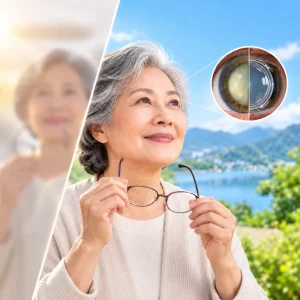
A cataract is the progressive clouding of the eye’s natural clear lens, which prevents light from focusing sharply onto the retina and causes gradual vision loss.
Cataracts are the leading cause of reversible visual impairment worldwide, affecting millions of aging adults as well as individuals with specific metabolic or ocular conditions. In Malaysia, population-based survey data from the National Eye Survey II (NES II) indicates that untreated cataracts remain the single largest cause of blindness, accounting for 58.6% of overall blindness cases nationwide (Chew et al., 2018). Understanding how and why cataracts develop allows patients and their families to seek timely ophthalmic care before vision loss impacts daily independence.
Causes and Risk Factors
- Aging: Natural structural changes in lens proteins over time cause them to clump together, turning a clear lens cloudy.
- Diabetes Mellitus: High blood sugar alters the fluid balance in the eye, causing the lens to swell and cloud faster than usual.
- Long-term Corticosteroid Use: Steroid medications change the protein makeup of the back surface of the lens, accelerating subcapsular clouding (opacity at the back of the lens).
- Excessive Ultraviolet (UV) Exposure: Solar radiation breaks down lens fibers, generating oxidative stress and cellular damage that speeds up lens opacity.
- Eye Trauma or Prior Surgery: Physical injury to the eye disrupts the delicate structure of lens cells, triggering localized cloudiness.
Stages of Cataract Development
| Stage of Cataract | What Happens to the Lens | What You May Notice |
|---|---|---|
| Early Stage | Small areas of the natural lens begin to become cloudy. | Mild glare, slightly blurred vision, or frequent changes in spectacle prescription. |
| Immature Stage | The cloudiness increases but the lens is not completely opaque. Light entering the eye becomes more scattered. | Increasing blurred vision, difficulty seeing at night, glare from headlights, and reduced contrast. |
| Mature Stage | Most or all of the lens becomes cloudy, significantly reducing the amount of light reaching the retina. | Significant vision loss that may make reading, recognising faces, driving, or moving around safely difficult. |
| Hypermature Stage | An advanced cataract may become very dense or undergo further degenerative changes within the lens. | Vision can become severely impaired. In some cases, complications such as eye inflammation or increased eye pressure (secondary glaucoma) may develop and require prompt treatment. |
Signs and Symptoms
What a Parent or Patient Might Notice at Home:
- Blurry, cloudy, or dim vision that glasses cannot fully correct
- Increased sensitivity to bright light and glare, especially from oncoming headlights
- Seeing halos around lights at night
- Faded perception of colors, making everything look yellowed or brownish
- Double vision in a single eye when looking through it alone
What Only a Clinician Can Detect:
- Specific patterns and density of lens opacification using a slit-lamp microscope (a specialized magnifying tool)
- Subtle loss of contrast sensitivity not captured by standard vision charts
- Changes in intraocular pressure caused by lens swelling
- Visual field changes and the health of the underlying retina behind the cloudy lens
Treatment Options
| Treatment | Best Suited For | How It Helps | What You Should Know |
|---|---|---|---|
| Prescription Eyeglasses (Non-Surgical Support) | People with very early-stage cataracts and only mild changes in vision. | A new prescription may improve focusing and help you see more clearly through the remaining clearer parts of the natural lens. | Glasses do not remove, reverse, or stop cataracts from progressing. They provide temporary visual improvement and may become less effective as the cataract worsens. |
| Phacoemulsification with Intraocular Lens (IOL) Implantation (Standard Surgical Treatment) | People whose cataracts are causing noticeable vision problems, including immature, mature, or dense cataracts. | Ultrasound energy is used to break up and remove the cloudy natural lens, which is then replaced with a permanent artificial intraocular lens (IOL). | Cataract surgery generally has a high success rate, but final vision also depends on other eye conditions such as macular degeneration, glaucoma, or diabetic retinopathy. Some patients may later develop posterior capsule opacification (PCO), which can usually be treated with a quick, non-invasive YAG laser capsulotomy. |
Screening and Prevention
While age-related cataract formation cannot be completely prevented, lifestyle modifications—such as wearing UV-blocking sunglasses, managing blood sugar levels, and avoiding smoking—are associated with a lower risk of early onset. Regular baseline eye screenings allow ophthalmologists to track lens changes and advise on the ideal timing for intervention. Per the Royal College of Ophthalmologists recommendations, access to cataract surgery should be determined by visual function and impact on daily life rather than rigid, arbitrary visual acuity cut-offs (Royal College of Ophthalmologists, 2018).