
Reviewed by Dr Norhafizah Hamzah, Paediatric Ophthalmologist & Squint Surgeon of OasisEye Specialists | Last updated: July 2026
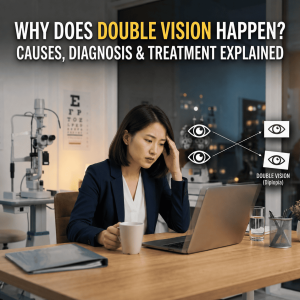
Have you ever looked at a single object and seen two overlapping copies of it? This is called diplopia, or double vision. It can be alarming the first time it happens, but understanding what causes it — and how treatable it usually is — can make it much less frightening.

What Is Double Vision (Diplopia)?
Normally, each eye sends a slightly different image to the brain, which fuses them into one clear, three-dimensional picture. Double vision happens when that process breaks down — either because the eyes aren’t pointed at the same spot, or because something inside one eye is distorting the image before it even reaches the brain. The first step in figuring out the cause is identifying which of the two main types you have.
Binocular Diplopia vs. Monocular Diplopia
A simple way to tell the two apart: cover one eye at a time.
- If the double vision disappears when either eye is covered, it’s binocular diplopia.
- If the double vision remains even with one eye closed, it’s monocular diplopia — and the problem lies within that specific eye.
Causes of Binocular Diplopia
Binocular diplopia occurs when both eyes are open, and it disappears as soon as one eye is closed. It happens when the images sent by each eye are not similar in position or sharpness for the brain to merge, usually because of strabismus — a misalignment of the eyes, also known as a squint.
Strabismus itself can stem from neurological or mechanical causes, including:
- Cranial nerve palsy
- Brain tumor
- Stroke
- Myasthenia gravis
- Graves’ disease (hyperthyroidism)
- Uncorrected refractive error
Causes of Monocular Diplopia
Monocular diplopia is double vision experienced in just one eye — it persists even when the other eye is closed. Common causes include:
Is Double Vision a Medical Emergency?
Most cases of double vision are not life-threatening, but some are — so it’s worth knowing the warning signs. Seek immediate medical attention if double vision appears suddenly and is accompanied by any of the following:
- Severe headache
- Slurred speech or difficulty understanding speech
- Facial drooping or weakness
- Numbness or weakness on one side of the body
- Loss of balance or coordination
- Eye pain or a bulging eye
- Recent head injury
These can be signs of a stroke, aneurysm, or other neurological emergency, and warrant urgent assessment. Even without these symptoms, any new or persistent double vision — sudden or gradual — should be evaluated by an eye doctor, since it rarely resolves on its own without identifying and addressing the underlying cause.
How Is Double Vision Diagnosed?
If you experience double vision, your eye doctor or optometrist will run a series of diagnostic tests to pinpoint the cause:
- Refraction — measures how light focuses in your eye to check for refractive errors.
- Cover Test — checks for eye misalignment that causes binocular diplopia by observing how each eye moves when the other is covered.
- Comprehensive Eye Examination — to rule out other eye conditions such as, dry eyes, corneal issues, and cataracts.
- CT scan or MRI — used to rule out brain-related causes such as tumors, aneurysms, or stroke.
- Blood Tests — elevated levels of certain antibodies or hormones can point to underlying conditions, such as myasthenia gravis or thyroid eye disease, that affect the eye muscles and nerves.
Treatment Options for Double Vision
Once the cause is identified, treatment is tailored to it. Common approaches include:
- Treating the Underlying Cause — if a condition like a brain tumour, stroke, or diabetes is responsible, treatment focuses on managing that condition first; the double vision often improves as it does.
- Prism Glasses — special lenses that bend light before it enters the eye, realigning the two images into one.
- Vision Therapy — structured eye exercises that can strengthen eye muscles and improve coordination and alignment over time.
- Strabismus Surgery — a procedure to adjust the eye muscles directly, used when misalignment is significant or doesn’t respond to non-surgical options.