Reviewed by Dr Diymitra K Ganasan, Refractive Surgeon of OasisEye Specialists | Last updated: August 2026
What is Flapless Eye Surgery?
Flapless eye surgery refers to vision-correction procedures that reshape or treat the cornea without creating a LASIK-style corneal flap, using techniques such as surface laser treatment or small-incision lenticule extraction.
Why Flapless Laser Eye Surgery Matters
Many patients are interested in laser vision correction but feel nervous when they hear the word “flap.” In traditional LASIK, the surgeon creates a thin hinged layer on the front of the cornea, lifts it, applies laser correction underneath and then places the flap back. LASIK can work very well for suitable patients, but some people prefer to explore options that avoid a corneal flap.
Flapless surgery does not mean “risk-free” surgery. It means the procedure uses a different way to reach or reshape the cornea. The main flapless laser categories are surface laser surgery, such as PRK or TransPRK and lenticule extraction, such as SMILE or SMILE pro 2.0. The American Academy of Ophthalmology describes refractive surgery as surgery that corrects focusing errors such as near-sightedness, far-sightedness, astigmatism or presbyopia by changing how light focuses in the eye.
This matters because refractive error is one of the world’s biggest eye-care issues. The World Health Organization reported in 2026 that at least 2.2 billion people globally have near or distance vision impairment, and refractive errors are among the leading causes of vision impairment and blindness. For suitable patients, modern refractive surgery may reduce dependence on glasses or contact lenses, but careful screening is essential because not every eye is suitable.
Causes and Risk Factors
Flapless laser surgery is not a treatment for eye disease in the usual sense. It is usually considered when a patient has a focusing problem, called a refractive error and wants to reduce dependence on glasses or contact lenses.
- Myopia, or short-sightedness: The eye focuses distant images in front of the retina, so distance vision looks blurred.
- Astigmatism: The front surface of the eye is shaped more like a rugby ball than a basketball, so light focuses unevenly and vision may look distorted or shadowed.
- Hyperopia, or long-sightedness: The eye focuses light too far behind the retina, so near work may feel strained and distance may also be blurred in some patients.
- Presbyopia: The eye’s natural internal lens gradually loses near-focusing ability with age, making reading harder even if distance vision is clear.
- Contact lens intolerance: Some patients explore surgery because contact lenses cause dryness, redness, allergy or inconvenience.
- Active lifestyle needs: Patients who play sports, work outdoors, travel frequently, or work in environments where glasses fog, slip, or get damaged may ask about flapless options.
- Concern about flap-related issues: Some patients prefer to avoid a LASIK-style flap, especially if they play contact sports or have lifestyle factors where eye rubbing or accidental impact is a concern.
- Corneal shape and thickness considerations: Some eyes may be more suitable for surface laser surgery, some for lenticule extraction, some for LASIK and some for non-laser options. Suitability depends on detailed corneal measurements.
- Dry eye or tear-film instability: Dry eye can affect comfort, measurements, healing and visual quality after any refractive procedure.
Classification: types of flapless laser eye surgery
Flapless laser surgery is best understood by how the cornea is treated.
Surface laser surgery: PRK and TransPRK
In surface laser surgery, the correction is applied on the surface of the cornea rather than under a flap. In PRK, the thin skin-like surface layer of the cornea is removed before laser reshaping. In TransPRK, the laser removes this surface layer and performs the vision correction in a single planned sequence, depending on the platform and patient suitability.
This category is often described as “flapless” because no corneal flap is made. It may be considered for selected patients with thinner corneas, certain lifestyle needs, or specific corneal profiles. Recovery takes a little longer than LASIK or SMILE Pro because the surface layer needs time to heal. During the first few days, it is normal to experience some temporary discomfort as the eye recovers. A 2025 systematic review of single-step TransPRK concluded that both two-step and single-step tPRK are safe refractive procedures and that single-step tPRK showed advantages in pain, haze, healing and visual acuity outcomes compared with two-step tPRK in the included studies.
Small incision lenticule extraction: SMILE and SMILE Pro
SMILE stands for Small Incision Lenticule Extraction. Instead of creating a flap, a femtosecond laser creates a thin disc-shaped layer of tissue inside the cornea, called a lenticule. The surgeon then removes this lenticule through a small incision and the cornea changes shape to reduce the focusing error.
The American Academy of Ophthalmology explains that SMILE Pro uses a laser to treat myopia and astigmatism and is performed through a small incision rather than a flap. A published SMILE review described the incision as typically ranging from 2 to 4 mm, with no corneal flap and preservation of the front corneal layers except around the incision area.
SMILE Pro and newer laser platforms
SMILE Pro generally refers to lenticule extraction performed on newer-generation femtosecond laser platforms, such as ZEISS VISUMAX 800, providing SMILE Pro 2.0 with workflow features intended to improve speed, centration, and alignment. ZEISS describes VISUMAX 800 as having a 2 MHz pulse repetition rate and the ability to create a lenticule in less than 10 seconds.
A 2025 Scientific Reports study comparing 100 eyes treated with VisuMax 800 and 100 eyes treated with VisuMax 500 found that mean lenticule creation time was shorter with VisuMax 800, at 10.33 ± 0.82 seconds compared with 28.27 ± 2.34 seconds. The authors also noted better centration-related findings with VisuMax 800, but longer follow-up and larger studies are still needed.
Non-laser flapless alternatives
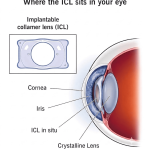
Some vision-correction procedures are flapless but not laser-based. Implantable Collamer Lens surgery, often called ICL, places a lens inside the eye while leaving the cornea largely unchanged. It may be considered for selected patients who are not suitable for laser corneal surgery, especially in higher prescriptions or thinner corneas.
ICL should not be grouped as “laser eye surgery,” because it works differently. It is better described as a lens-based refractive surgery option.
Signs and Symptoms
What only a clinician can detect
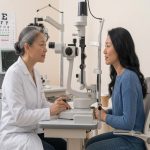
A patient may know they are dependent on glasses, but only a detailed refractive assessment can show whether flapless surgery is suitable. A refractive surgeon can detect:
- The exact type and amount of short-sightedness, long-sightedness or astigmatism
- Whether the prescription is stable enough for surgery
- Corneal thickness and corneal shape
- Early keratoconus or suspicious corneal thinning
- Dry eye or tear-film instability
- Pupil size and night-vision risk factors
- Corneal higher-order aberrations, which are fine optical distortions that can affect quality of vision
- Whether the eye is better suited to TransPRK, SMILE Pro, LASIK, ICL or no surgery
- Retina or optic nerve problems that may limit visual outcome even if the laser correction is accurate
What a patient might notice at home
Patients often consider flapless laser surgery when they notice:
- Blurry distance vision without glasses or contact lenses
- Dependence on glasses for driving, sports, travel or work
- Contact lens dryness or discomfort
- Glasses fogging, slipping or interfering with activity
- Difficulty seeing clearly at night
- Headache or eye strain when the prescription is not updated
- Unequal vision between both eyes
- Lifestyle inconvenience from glasses or contact lenses
Patients should seek a refractive assessment if their prescription feels unstable, if vision is worsening despite new glasses, if contact lenses are uncomfortable or if they are considering surgery. Seek urgent eye care instead of refractive screening if there is sudden vision loss, pain, flashes, new floaters, severe redness, discharge or injury.
Treatment Options
| Procedure | Best suited for | How it works | Recovery |
|---|---|---|---|
| TransPRK | Myopia, astigmatism, thinner corneas, active lifestyles | Surface laser removes the epithelium and reshapes the cornea in a single-step sequence | Slightly slower than LASIK and SMILE (surface healing required) |
| PRK | Patients requiring surface laser treatment instead of LASIK | Surface layer removed before the excimer laser reshapes the cornea | Slower than LASIK and SMILE |
| SMILE Pro 2.0 | Suitable for patients with myopia and astigmatism | Small lenticule removed through a tiny incision without creating a flap | Fast |
| Conventional SMILE | Myopic and astigmatic patients | Similar lenticule extraction using an older laser platform | Fast |
| LASIK | Suitable for refractive surgery candidates | Corneal flap created before laser reshaping | Fast |
| ICL (non-laser option) | High prescriptions or thinner corneas unsuitable for laser | Implantable lens placed inside the eye | Very fast |
Screening
Flapless laser surgery cannot make an unsuitable eye suitable. The most important safety step is careful screening before surgery.
A refractive assessment may include:
- Detailed glasses power and refraction testing
- Prescription stability review
- Corneal topography and tomography, which map the front and deeper shape of the cornea
- Corneal thickness measurement
- Dry eye and tear-film assessment
- Pupil size and night-vision assessment
- Eye pressure measurement
- Retina and optic nerve examination
- Discussion of job, sports, lifestyle, pregnancy plans, contact lens history, and expectations
- Review of whether TransPRK, SMILE Pro, LASIK, ICL or no surgery is most appropriate
The FDA-approved SMILE indication specifies adult age, prescription range, astigmatism range, and documented stability criteria; patients outside these ranges need specialist assessment rather than assuming treatment suitability. The FDA also advises that after laser vision correction, vision may take up to 3 to 6 months to stabilise, and symptoms such as glare, halos, difficulty driving at night and other visual symptoms may persist during that period.
There is no way to guarantee that side effects will not happen. However, careful screening can reduce the chance of treating an eye where the risk is too high or the expected benefit is too limited. Patients should also understand that while laser vision correction reduces dependence on glasses or contact lenses, it does not prevent ageing changes such as presbyopia, cataract, glaucoma, retinal disease or future prescription changes.