Reviewed by Dr Wilson Wong Jun Jie, Vitreoretinal and Refractive Surgeon of OasisEye Specialists | Last updated: September 2026
Refractive errors—blurry vision caused by light bending incorrectly as it enters the eye—affect millions of people, making everyday tasks dependent on glasses or contact lenses.
When light does not focus directly on the light-sensitive layer at the back of the eye (the retina), close or distant objects appear blurry. Refractive surgery resculpts the transparent front window of your eye (the cornea) so that incoming light focuses accurately, restoring clearer natural vision.
Historically, procedures like traditional LASIK required making a wide, circular hinged cut (a corneal flap) across the surface of the eye to reshape the underlying tissue. Modern laser vision correction has shifted toward keyhole, flapless procedures. This article outlines the key technical and clinical differences between the first-generation keyhole technique (ReLEx SMILE) and its newest iteration (SMILE Pro 2.0).
Causes and Risk Factors of Refractive Errors
Refractive errors develop due to variations in the physical shape and length of the eyeball, which prevent light rays from coming to a sharp focal point.
- Elongated Eyeball (Axial Myopia): An eyeball that grows slightly too long from front to back causes light rays from distant objects to focus in front of the retina rather than directly on it, resulting in short-sightedness.
- Irregular Corneal Curvature (Astigmatism): A cornea shaped more like a rugby ball than a football bends light unevenly across different directions, creating distorted or double vision at all distances.
- Corneal Steepening or Flattening: Natural genetic variations in the steepness of the corneal surface shift the focal point of light away from the retina.
- Extended Soft Contact Lens Wear: Prolonged, continuous contact lens use can temporarily alter corneal shape and increase the risk of surface inflammation, requiring a contact lens holiday prior to laser suitability testing.
Signs and Symptoms
What Only a Clinician Can Detect During Examination
- Corneal Thickness Mapping (Pachymetry): Precise micron-level measurement of your corneal wall to ensure enough structural tissue remains post-surgery.
- Corneal Topography and Tomography: Computerized 3D mapping that screens for subtle irregularities, tissue weakness, or hidden steep spots (such as early keratoconus).
- Epithelial Thickness Mapping: Assessment of the outermost cell layer of the eye to confirm underlying corneal stability.
- Tear Film Stability Metrics: Objective measurements of tear production and evaporation rates to evaluate pre-existing dry eye.
What You Might Notice at Home
- Squinting or eye strain when reading street signs, looking at screens, or driving at night.
- Frequent headaches localized around the forehead or temples after prolonged visual tasks.
- Halos, starbursts, or glare surrounding headlights and streetlamps during nighttime driving.
- Persistent dryness, burning, or a sensation of grit under the eyelids after contact lens use.
Treatment Options: ReLEx SMILE vs. SMILE Pro 2.0
Both ReLEx SMILE and SMILE Pro 2.0 are flapless, keyhole laser procedures designed to correct short-sightedness and astigmatism. Instead of creating a flap, a high-precision laser cuts a tiny, 3D disc of tissue—called a lenticule—inside the intact cornea. The surgeon then removes this lenticule through a microscopic keyhole incision measuring just 2 to 4 millimetres. While both methods achieve comparable long-term visual acuity, their underlying technology platforms differ significantly.
| Feature | ReLex SMILE (First Generation) | ZEISS SMILE Pro 2.0 (Next Generation) | Clinical Relevance |
|---|---|---|---|
| Laser Platform | ZEISS VISUMAX 500 | ZEISS VISUMAX 800 | Upgraded hardware generation |
| Laser Repetition Rate | 500kHz | 2 MHz (2,000 kHz) | Higher speed allows faster tissue carving |
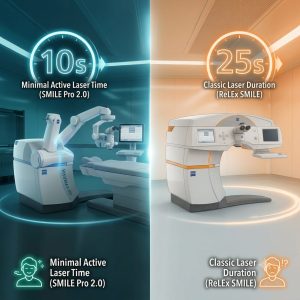
| Active Laser Runtime | ~25 to 27 seconds per eye | ~8-10 seconds per eye | Slashes surgical contact time by ~65% |
| Fixation / Suction Contact | Standard contact glass | Ultra-short contact window | Shorter hold time minimizes eye pressure exposure |
| Digital Alignment Systems | Manual surgeon centration | Automated CentraLign & OcuLign | Compensates for tiny eye rotations automatically |
| Incidence of Suction Loss | Published rate ~0.5% (with ~65% occurring after sec 10) | Substantially lower due to <10 sec duration | Minimizes procedural interruptions |
Category 1: ReLEx SMILE (VisuMax 500 Platform)
- What it is: The original flapless lenticule extraction procedure, introduced clinically over a decade ago.
- What it’s for: Correction of myopia and astigmatism without creating a large corneal flap.
- Limitations & Variable Outcomes:
- Active laser creation takes roughly 25 to 27 seconds per eye, during which the patient must maintain a steady gaze.
- According to published clinical data, suction loss (where the gentle holding ring disconnects mid-procedure) occurs in approximately 0.5% of cases, with roughly 65% of those instances taking place after the 10th second of laser application.
- Eye alignment for astigmatism relies primarily on manual marking and surgeon alignment rather than automated digital tracking software.
Category 2: ZEISS SMILE Pro 2.0 (VisuMax 800 Platform)
- What it is: The latest refinement of flapless lenticule extraction utilizing a 2 MHz laser system and integrated digital assistance.
- What it’s for: Rapid keyhole vision correction, particularly advantageous for anxious patients or those with significant astigmatism.
- Limitations & Variable Outcomes:
- While the active laser stage takes under 10 seconds, total surgical suite preparation and extraction time still require several minutes per eye.
- As with all refractive procedures, individual healing rates vary; visual recovery typically takes 24 to 48 hours for functional vision, but fine contrast sensitivity may continue stabilizing over several weeks.
- Regression (a partial return of short-sightedness over years) remains a biological possibility over a patient’s lifetime regardless of laser speed.
Screening and Disease Prevention
While laser vision correction alters corneal shape, it does not change the overall biological health or underlying length of the eye. The majority of cases of post-operative complications or unsatisfactory visual outcomes are associated with delayed screening or inadequate pre-operative diagnostic mapping.
- Comprehensive Pre-Operative Screening: Advanced 3D corneal mapping (tomography) screens for hidden structural weakness (such as subclinical keratoconus) before any laser touch.
- Stabilization Monitoring: Verifying that your vision prescription has remained unchanged for at least 12 months helps prevent post-surgical regression.
- Routine Retinal Checks: Short-sighted eyes retain a longer axial length, which carries a higher baseline risk of retinal tears or detachment regardless of whether refractive surgery is performed. Regular dilated eye examinations remain essential throughout life.