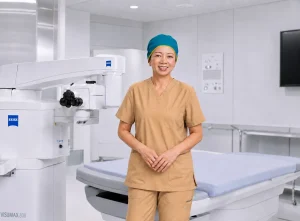
Medically reviewed by Dr Khaw Hoon Hoon, MD (UKM), FRCS Ophth (Glasg), FWCRS, Refractive Surgeon, OasisEye Specialists
Last reviewed: October 2026
Laser vision correction has evolved from surface treatments and flap-based surgery to procedures that remove a thin layer of corneal tissue through a small incision. SMILE pro is a newer version of this flapless approach, performed with a faster femtosecond laser that includes digital alignment aids. This article explains how SMILE works, how it compares with other options, and what current research does and does not show about the newer platform. [1,2]
Understanding refractive errors: context and impact
Refractive errors occur when the eye does not focus light clearly on the retina, the light-sensitive layer at the back of the eye. Myopia (short-sightedness) causes blurred distance vision; hyperopia (long-sightedness) can make near tasks difficult; and astigmatism results from unequal focusing power in different directions. [3]
Myopia is a growing public health concern. A landmark modelling study projected that nearly half of the global population could have myopia by 2050. In Malaysia, a 2026 review of 17 studies estimated that about 25% of children aged 4–18 years had myopia (plausible range 15–37%). After the authors adjusted for bias from small studies, the estimate fell to about 16% (range 7–28%). Prevalence rose with age, from about 1% in preschool children to about 30% in primary school children. [4,5]
Glasses and contact lenses correct focusing errors without surgery. Some contact lens wearers experience dryness or discomfort. Laser vision correction reshapes the cornea, the clear front surface of the eye, to reduce dependence on glasses or contact lenses. It does not guarantee lifelong freedom from them. [3,6]
Causes and risk factors
- Axial myopia: the eyeball is too long relative to its focusing power, so light focuses in front of the retina. [3,7]
- Astigmatism: the cornea or natural lens has different curvature or focusing power in different directions, causing blurred or distorted vision. [3,7]
- Genetics and environment: parental myopia is associated with childhood myopia. Evidence linking near work to myopia is less consistent. Spending more time outdoors helps reduce the risk of myopia onset. [8,9]
Severity: what your prescription means
A prescription is measured in dioptres (D), a unit of optical power. The International Myopia Institute defines myopia using the spherical equivalent, a combined measure of the spherical and astigmatic prescription. The following three categories are a practical patient-education subdivision; the formal IMI standard distinguishes low and high myopia at −6.00 D. [10]
| Myopia category | Spherical equivalent |
|---|---|
| Mild | −0.50 to −2.99 D |
| Moderate | −3.00 to −5.99 D |
| High | −6.00 D or more negative |
A higher prescription does not automatically rule out surgery. Corneal shape, thickness, eye health and other factors also determine eligibility. High myopia increases the risk of retinal complications; laser correction does not shorten an elongated eyeball or remove these risks. [6,11]
Signs and symptoms
- Blurred distance vision, difficulty reading road signs or seeing presentation screens. [7]
- Squinting (narrowing the eyes to see more clearly), visual fatigue or headaches associated with focusing effort. [7]
- Blurred, distorted or shadowed images, especially with astigmatism. [7]
- Glare or halos around bright lights. [7]
These symptoms are not unique to refractive errors. Sudden double vision, or double vision with eye pain, requires urgent medical assessment. Go to the emergency department immediately if blurred or double vision occurs with a severe headache or an enlarged pupil, or if double vision follows a head injury. [12] New flashes, a sudden increase in floaters or a curtain-like shadow require immediate assessment by an eye doctor or emergency department. [13] Sudden loss of vision in either eye requires emergency care immediately. [14] In Malaysia, call 999 for emergency help.
What can an eye examination detect?
- The exact spectacle prescription and astigmatic axis through objective and subjective refraction. [3,6]
- Corneal shape and thickness, including screening for abnormal thinning or distortion. [3,6]
- Tear film stability and ocular surface disease, including dry eye. [3,6]
- Health of the natural lens, optic nerve and retina, with dilation when indicated. [3,6]
What is SMILE pro?
SMILE stands for small incision lenticule extraction. A femtosecond laser creates a thin, lens-shaped piece of tissue (a lenticule) inside the cornea. The surgeon separates and removes it through a small opening, changing the shape and focusing power of the cornea without creating a LASIK flap. [1,2]
SMILE pro is SMILE performed on the newer VISUMAX 800 laser. Conventional SMILE was performed on the earlier VISUMAX 500. [1,2]
Treatment options: the evolution of laser vision correction
PRK (including TransPRK),FemtoLASIK and SMILE are established approaches. The most appropriate procedure depends on the individual eye, prescription and lifestyle, not simply on the newest available technology. [6]
| Procedure | PRK / TransPRK | FemtoLASIK | Conventional SMILE | SMILE pro |
|---|---|---|---|---|
| Technique | Surface laser reshaping | Flap-based laser reshaping | Small-incision lenticule extraction | Small-incision lenticule extraction |
| Laser | Excimer | Femtosecond + excimer | VISUMAX 500 | VISUMAX 800 |
| Typical indications | Selected myopia, hyperopia or astigmatism | Selected myopia, hyperopia or astigmatism | Myopia with or without astigmatism | Myopia with or without astigmatism* |
| Laser lenticule creation | Not applicable | Not applicable | Typically 25–30 seconds [19] | Under 10 seconds for myopia (manufacturer data) [1] |
| Recovery | Slower surface healing | Often rapid initial recovery | Generally rapid | Generally rapid; manufacturer reports vision may improve from the next day [2] |
| Main advantages | No flap | Rapid initial recovery | No flap; potential early ocular surface benefits | Shorter laser phase; digital alignment aids |
| Considerations | Early discomfort; haze risk | Flap-related risks; dry eye | Dry eye; lenticule-related risks | Similar risks to conventional SMILE |
Sources: ZEISS technical documentation, AAO guidance and comparative studies. [1,2,6,15,16,19]
*Hyperopic SMILE pro is described in international ZEISS documentation, but availability and approved indications vary by market. This article focuses on myopia and myopic astigmatism. [2]
What changed with the newer laser platform?
- Faster laser delivery: according to ZEISS, the 2 MHz VISUMAX 800 can create a myopic lenticule in under 10 seconds per eye (manufacturer data for optical zones of 6.5 mm or smaller). This is the laser phase only, not the duration of suction or the whole operation. [1]
- CentraLign: a digital aid that helps the surgeon centre the treatment on the eye. [1]
- OcuLign: an alignment aid that helps compensate for rotation of the eye (cyclotorsion), which matters when treating astigmatism. [1]
These are design features described by the manufacturer. Whether they improve results for patients is a separate question, covered below.
What does the latest research say?
A systematic review published in November 2026 pooled 13 comparative studies involving 2,259 eyes. On average, the VISUMAX 800 shortened lenticule creation by about 18 seconds compared with the VISUMAX 500. The review found no statistically significant difference in unaided distance vision, prescription accuracy or higher-order optical aberrations, although meaningful differences cannot be ruled out. Twelve of the 13 studies were non-randomised, and the authors rated the certainty of the evidence as low or very low. Suction loss was rare with both lasers. [15]
A separate July 2026 review of nine studies reported that astigmatism was more often corrected within 5 degrees of the intended axis with the VISUMAX 800. Whether this makes a noticeable difference to everyday vision has not been established, and most of the included studies had a serious risk of bias. [19]
A surgeon’s perspective
When recommending PRK, FemtoLASIK or SMILE, I consider each patient’s prescription, corneal thickness and shape, ocular surface health, lifestyle and visual expectations. No single procedure is suitable for everyone, and the latest technology is not necessarily the best option for every patient. I also explain the expected recovery timeline, potential risks and realistic visual outcomes so that patients can make an informed decision. My priority is to recommend a procedure that balances safety, visual quality and long-term eye health.
Limitations and potential risks
SMILE may preserve corneal sensitivity and tear film stability better than FemtoLASIK during recovery. A 2025 review of 18 studies found advantages in two objective measures, tear film stability and corneal sensitivity, but no statistically significant difference in patient-reported dry-eye symptom scores or tear production tests. Dry eye can still occur after either procedure. [16]
Although SMILE avoids a large flap, it still removes corneal tissue and changes its structural properties. Potential complications include temporary dryness, glare, halos, fluctuating vision, residual prescription, infection or inflammation, difficulty removing the lenticule and, rarely, progressive corneal weakening (ectasia). Some patients may need glasses or further treatment. [6,17]
Long-term studies of conventional SMILE show generally favourable stability. In a small study of 32 eyes followed for ten years, the average myopic shift was 0.32 D. This is an average change across the group, not the percentage of patients whose prescription returned, and ten-year results from conventional SMILE cannot be directly applied to the newer VISUMAX 800. [18]
Screening and preoperative assessment
Laser vision correction is elective. The surgeon will assess whether the expected benefits outweigh the risks for your eyes. [6]
- A stable prescription and appropriate age and treatment range, as assessed by the surgeon. [6,17]
- Corneal topography or tomography and thickness measurements to identify abnormal corneal shape, keratoconus or inadequate residual tissue. [6,17]
- Tear film and eyelid health; significant dry eye or inflammation should be treated before surgery. [6]
- Relevant medical conditions, medications, pregnancy or breastfeeding, and other factors that may affect healing or prescription stability. [6]
- Retinal and overall eye health, particularly in people with high myopia, and realistic expectations for vision after surgery. [6]